Sunday, October 27, 2013

$15 Magic

Las Vegas. January 2006.

“Yes, Mr. Marshburn. I am calling you back in regard to your application for health insurance with our company.”

“Yes, sir?” I respond over my cell phone. I am standing in the break room of the car dealership.

“You listed that you presently take Accutane?”

“That is correct.”

“You also listed that you were diagnosed with colitis one year ago?”

“Yes, that is true.”

“Because of these medical issues, I am sorry, but you do not qualify to be insured by our company,” the man on the other end of the line says.

***

Eventually, after being turned down by a few other health insurance companies, I find one that will insure me for certain things, with a $5000 deductible. So, at least I do not have to worry about going bankrupt if I get into a car accident out here in Las Vegas. My job with the car dealership does not offer health insurance benefits.

***

Cullowhee, North Carolina. 2008.

While in graduate school, I write a blog entry encouraging our political leaders to reform health care. I write that the public will thank them for it and even build statues in their honor because of it.

***

Live Oak, Florida. Present Day.


The hunched over lady limps up to the receptionist window of the doctor’s office. I watch as she fumbles around in her pocket book. Her shoes are worn and dirty, her clothes simple. I was here in the waiting room when she was called back to see the doctor. Now, she has come out, and it is time to pay the bill.

“How much is it going to be?” she asks the receptionist.

“$175, Ms. Graham.”

The lady looks down.

The door between the waiting room and the treatment rooms opens. A nurse calls out, “Nathan!”

I stand up. The others, old and sickly for the most part, look at me, a healthy young man wearing a suit and tie.

I walk back, see the doctor, and within 15 minutes am again standing in front of the receptionist counter. She gives me back my Blue Cross/ Blue Shield health insurance card that I have by virtue of being a state employee.

“That will be $15,” she says.

***

Over the past couple of weeks, through conversations on Friday night at the Brown Lantern Bar, through lunch conversations at the Downtown Café or other restaurants in Live Oak, I have learned that I am perhaps the only person in Suwannee County who supports Obama care.

One of the attractive waitresses at the Brown Lantern asked me last week what everyone was arguing with me about. They had all ganged up on me.

“I’m defending Obama care,” I tell her.

A shocked look comes over her face. “Boo!” she says to me.

The restaurant most likely does not give her health insurance. She is married to a cop, though, so she would have benefits through his job.

Across the country, it seems that I have misjudged the way many Americans would react to health care reform. It is still early, though. Obama care has not had time to work, yet.

The most vociferous detractors of health care reform strike me to be people who have had government or company provided health insurance almost their entire lives. A lot of them are military veterans.

Perhaps I am wrong, but I think those that argue with me believe they deserve the benefit of health insurance because of the hard work they have done and the position they have achieved in life. Others in society who have not worked as hard do not deserve the same benefit.

If that is their position, then I come from a simply different moral philosophy. Health care should not be a reward for hard work. Everyone should have it, regardless of what has happened to them or where they are in life. Sure, those who disagree with Obama care have worked hard, but there is an element of luck involved in this, too. Not everyone can have a government job. Not everyone can make a career with a good company that provides benefits. There are winners and losers in life. But the losers should still have something as basic as affordable health care.

Almost everyone who has argued with me on Obama care also claims to be a Christian and attends church, so far as I know. I will admit that, despite the best efforts of my parents to raise me as a Southern Baptist, I do not consider myself a Christian and have not been to a church service since 1998. Still, this opposing stance (to me) does not seem to be in line with what Jesus would do. The disregard for their fellow humans appears to be a contradiction to his teachings.

“We can’t afford it bro!” One guy said to me at the bar. “We can’t afford to take care of everyone in society. If people think it is bad here, they should go to the Dominican Republic and see how people live there. My church did a mission trip there.”

“We have to try,” I answered him. “And if we can’t afford it, then we need to reprioritize our spending. The old health care system was broken. We have to try something different. Also, you shouldn’t hold up the Dominican Republic as a model. America should be the model for the rest of the world.”

Perhaps there is something genetic, or engrained in our DNA about this argument.

One of my friends from law school sends me a weekly write up that he does for his investment firm. He is a nice guy and has always been very successful. He played football for an ACC school and still stays in tremendous shape.

He posted an article on his social media page and called it “Spot Me Some Entitlements, Bro!” The article was a dagger of a piece, basically saying that men with more upper body strength tend to be conservative in their political thinking, while men with less upper body strength tend to be liberal and favoring wealth redistribution. The idea is that strong men do not need the help. Going back to prehistoric times, they can go out and hunt whatever they need. Weaker guys need more help from the community to provide for them and their families.

http://www.dailymail.co.uk/health/article-2325414/Men-physically-strong-likely-right-wing-political-views.html

Maybe he has a point, or maybe it is all nonsense. I do not know. I acknowledge that part of what shapes my thinking on this is from selfish personal experience- I have had some health issues, and it startled me when I could not get health insurance. All my savings could be wiped out in an instant through no fault of my own. Also, being successful is not so easy, at least for me. Keeping a job and building wealth has proven to be a continuing challenge.

I also acknowledge that I am no expert on how Obama care will work or how it is supposed to work. The old system was a wreck for many Americans, though, and we can do better. The reaction of many of my friends and colleagues to Obama care has surprised and puzzled me. But I find that the older I am getting, the less certain I am of many things.


Sunday, October 20, 2013

Athleticism

Lumberton, North Carolina. 1989 or 1990

The basketball is loose, near the sideline. I sprint for it and get there first.

Oh, man. Here I am, charging on a fast break down the basketball court at Littlefield High School.

Littlefield is a grade 7th through 12th school, but the total student body population is only about 600. I am in 8th grade, playing a game of pickup basketball with my brother and some friends.

I have watched several high school basketball games on this court, and the players are larger than life to me in the green and gold (yellow) uniforms and “Hornets” insignia. One guy on the team, Tim, can jump so high that when he takes a jump shot, it looks like he is shooting down on the goal.

This is also the floor where I sit in the bleachers and watch the pretty Littlefield cheerleaders. I am in love with one of the cheerleaders, a red head named Amy. She has never paid attention to me, though. The cheerleaders do their routines during the timeouts, and then jog back over to the first row of bleachers when the game begins again. After their routines, one cheerleader does a slow split as the others jog off. It is a sight forever etched in my brain, her smiling at the crowd as she slides to the floor with her tan legs. She holds the pose for a moment, and then gets up to join the other girls.

I run past the exact spot on the floor where she performs those incredible splits, going as fast as I can while bouncing a basketball.

The gym also has a stage for plays and school presentations. Coach T sits on the stage in a metal folding chair, watching our pickup game. Coach T is an all-around good coach for any sport. I want to impress him because he is the high school baseball coach, and that is the team I would like to join more than any other.

I do not know if anyone is behind me, catching up to steal the ball, but I don’t dare look. The basket is only a few more feet ahead.

The white bordered square on the glass backboard looms ahead of me. When shooting the ball, I have been taught that you should concentrate on the back of the rim- unless you want to bank the shot in. If you want to bank it off the glass, then make sure the ball hits in the middle of that square, and it will go in.


I cannot dunk a basketball, so this is going to be a lay-up off the glass.

Hit the square, I think to myself. Hit the square.

I am under the goal, now, still running about as hard as I can go. I put the ball up with two hands, like a chest pass, and it hits the center of the glass square perfectly.

Instead of going into the hoop, though, the ball launches backward and lands well behind the three point line. It bounces clear back to half court.

Everyone sort of freezes in stunned silence. Coach T has his arms crossed on his chest, and keeps a stoic expression. My friend, Ron, is the first to burst out in laughter. He puts his hands on his knees and doubles over.

My brother, a very good basketball player, just stares at me. We are both at an awkward age where we do not say much to each other in public, in front of other people. But once we are home, he lets me have it.

Years later, even in the present, he still talks about that play.

“We were all just shocked,” he says. “I couldn’t believe that you were that uncoordinated. I mean, the ball bounced back to half court. Didn’t you know how to make a lay-up?”

“I hit the square!” I answer defensively. “I was always told that if you hit the square, the ball will go in!”

After that disastrous attempt at a lay-up, I work on my technique a little more and learn that if I go up with one hand and pull the ball back from the backboard just before I release, then it takes away the momentum of my sprint and softens the bounce against the square. The ball should go in.

Luckily, no girls were around to watch that spectacle of athleticism.


Sunday, October 13, 2013

The Ferris Wheel

Kissimmee, Florida. February 2012.

I can hear the crowd cheering inside the Silver Spurs Arena. The rodeo has already started. I have never been to a rodeo in person, and I was looking forward to this. I debate whether or not to buy a ticket and see what is left.

"Excuse me, ma'am?" I say to a lady on the other side of the glass window at the ticket booth.

"Yes, sir?"

"Do you know if they've had the bull riding, yet?"

"Yeah, that's one of the first things they did. It's over, now."

That decides me. The bulls were the main thing I wanted to see.

"Okay. Thank you."

"I'm sorry," she says.

I smile at her and walk away from the arena. About fifty yards to the south is the entrance to the Osceola County Fair. Florida seems to hold their county fairs in the winter, which is definitely a change from where I grew up in North Carolina. I have always associated the fair with early autumn or even Halloween.

Night has fallen here in Kissimmee, and I stand in line for my ticket with talkative teenagers and guys wearing cowboy hats with girls hugging their arms.

"How many?" the man in the booth asks me when it is my turn at the window.

"Just me," I say.

"Just you?" he echoes.

"Yep."

"That'll be five dollars."

Once inside the grounds, I walk around for a bit, to take a look at all the attractions.

The predominant feature is the Ferris wheel. I have never ridden on one of these, either, and I think back to a story that my dad told me from his childhood.

He was at a fair, probably the Pender County Fair in North Carolina in the late 1950s or the early 1960s. He rode a Ferris wheel for the first time, along with his brother and a friend. Dad said that he was amazed by all that he could see, as he had never been so high in the air before. He had a royal time, too, as the Ferris wheel operator apparently forgot they were on board. They rode for about half an hour.

I think I want to go up in the Ferris wheel. In the darkness, I know that I will only be able to see lights down below, but I am still curious.

There is quite a long line of people, and I am hungry. So I buy a hot dog and a bottle of water to eat and drink while I wait.

After about ten minutes, I am close enough to the base of the wheel to see a sign that gives me pause. It reads in all caps: "NO SINGLE RIDERS." I have waited this long, though, and I do not know when the opportunity to ride a Ferris wheel might present itself again. So I stay in line.

Four men stand at the base, loading the passengers into the gondolas. As I watch them, I see that they are carefully picking and choosing who goes into each one. The gondolas swing back and forth on the rim of the wheel, and I suppose balancing each of the gondolas is an important thing.

Finally, it is my turn to get into one.

"Who else you got with you?"

"It's just me," I say.

"Aaah," the man exhales, scratching his forehead. "I can't put you in one by yourself."

"It screws up the balance?" I ask.

"You got it." He thinks for a moment. "Here, you can get in this one."

I sit for a minute by myself while people climb into a couple of other gondolas. Then one of the men directs a family of three to get into the gondola with me.

The family stands frozen for a moment. It is a young couple, younger than me, probably, with a small boy. The woman is pretty obese, and the guy is big, too, but in a brawny style. He is 6'2" or 6'3".

"Can we have a car by ourselves?" the woman asks.

"Sorry," the man answers. "I've got to put you in with him."

The husband tries to usher his wife in.

"I don't want to ride with him!" she says loudly.

This obviously embarrasses the husband, who strikes me as a good ole' country boy. When she sees his embarrassment, I suppose it occurs to her as well how she must sound, so the entire family climbs in with me.

I look at them and shrug sheepishly. "Sorry."

They say nothing, the husband shyly looking down at the floor of the gondola.

The Ferris wheel starts up. The kid has his head on his mom's shoulder, and he is staring at me. The mom has a small, sour frown on her face and avoids eye contact with me, though she is staring at her husband and seems to be wanting some reaction.

I turn and look out over the countryside. Though I cannot see them in the night, I know that the fair grounds below are surrounded primarily by open fields. In the distance to the north, I see a lot of lights. I wonder if these are the lights of Orlando. To the northwest horizon is another set of lights, some of which are neon red and blue. I wonder if this is part of Disney World- if I can really see that far. It would be nice to know. Instead, the lights remain a mystery.

The ride is over soon. The family and I climb out, quickly replaced by a young couple.

I do not hang around at the fair much longer after my ride on the Ferris wheel. Next time the chance comes up, perhaps it will be in the day- or at least I will know what I am looking at from high in the air. Maybe next time, too, a cute girl will be with me and I will not have to stress out a family of three... Maybe, but I have learned not to hold my breath, and to instead go ahead and take the chances when they arise.

Sunday, October 6, 2013

David Copperfield

Las Vegas. Spring 2005.

"There must be some mistake. I think you are at our table."

I look up and see an older, balding man with intense blue eyes peering down at me. To his left is a beautiful woman with reddish brown hair. To his right is a fit looking guy, probably only a few years older than me. The younger man wears small glasses and looks intelligent.

"Really? I don't know," I answer. "I just sat down where the usher told me. "

People are flooding into the theater, which is not that large, and taking up the seats quickly. So this group of three decide to sit down at the table with me.

The theater is filled with cocktail tables covered with white cloths. The tables seat up to four people, though only two people are at most of the tables. The four of us are sort of crowded in together.

"What is your name?" the younger guy asks me.

"My name is Nathan. I'm out here on vacation."

"By yourself?"

I smile. At this point in my life, I am growing more comfortable with being alone, in going to social events alone. I am getting more used to people thinking of that as a little odd. "Yes, I'm by myself. How about you guys?"

"It's a sort of business trip," the older man says, studying me carefully. "This is Dan, my accountant."

I smile and nod to him. I look at the woman and smile at her, too, though I decide not to ask who she is.

Dan seems like a nice guy, but the older fellow is obviously irritated by my presence.

"Is this your first time to Las Vegas?" Dan asks.

"No, I came out for the first time in 2003."

"You know, I was hoping to be able to talk business with my colleagues here," the older man says.

The abruptness of his comment startles me. I do not know how to respond. "Oh, I'm sorry."

I look around. There is one empty table left close by. "I suppose I can ask the usher to move me to that table."

The older man gives me a look like he is trying to keep from yelling at me to do it, to move. At that moment, though, an usher seats two women at the table. It is a full house, now- no empty tables left. A waiter brings each of us a cocktail, which is included in the price of the ticket.

The friendly thing might be for us all to clink glasses and say "Cheers!" But we do not do it. The look on Dan's face is unfortunate. The older man is not happy, now, and this is not good for Dan, I can tell. The woman seems apathetic to it all.

I sip my cocktail. It might be a great cocktail, but I would not know. I have only recently started drinking, and nothing tastes that good to me. No matter what the mix, the flavor and odor of alcohol is overriding.

I try to be affable. "When I saw that David Copperfield was performing in Vegas, I knew this would be a rare chance for me. I grew up in North Carolina. He is the first magician I ever remember seeing on television. He made the Statue of Liberty disappear when I was a kid."

Dan forces a brief smile. The older man does not. The woman is looking away, uninterested.

"Where are you guys from?" I ask.

No one speaks for a moment.

"You don't know who I am?" the older man asks.

This surprises me. The glare and intensity of his eyes are something, but I take a moment to study his face anyway.

"No."

"Really?" he asks. "You have no idea who I am?"

"I'm sorry," I answer. "Should I? What is it that you do?"

"I'm a businessman," he says, looking away as he speaks with what might be described as disgust.

The lights to the theater go down. From his tone and expression, I decide not to ask him further questions.

The show is great. David Copperfield is only a few feet away on stage, and I keep my eyes there the entire time, rather than looking at my three unhappy table companions.

Toward the end of the show, Copperfield says that his parents are in the audience, and a spotlight shines on their table. It is only three away from ours, and actually further back. The parents are both dressed nicely, in evening ballroom style.

When the show ends and the lights come back up, I tell the three sitting at my table, "I hope you enjoy the rest of your time in Vegas."

"Thank you, you as well," Dan answers. The older man and the beautiful woman say nothing.

The crowd filters out, but Copperfield's parents stay seated at their table, probably waiting to speak to their son.

As I walk by them, I say, "I enjoyed your son's show." They acknowledge me with a nod.

***

After my return from Vegas to North Carolina, I studied my credit card bill. I noticed that the price of the ticket to the show was not charged. It was an expensive ticket, and I keep waiting for the charge to appear on my monthly bills. It never does.

Only years later does it occur to me that the older man or Dan probably complained to the theater about what happened, and that everyone at the table got to see the show for free.

It is not the first time, and it is not the last time, when I go alone to a social event and find myself, through no control of my own, plugged in with a romantic couple or a group of people who do not want me there. Another instance that comes to mind is the Osceola County Fair in the spring of 2012. I will tell that story next week.

At least I got to see David Copperfield's show for free.

Sunday, September 29, 2013

The Cross Country Team

Lumberton, North Carolina. Fall, 1994.

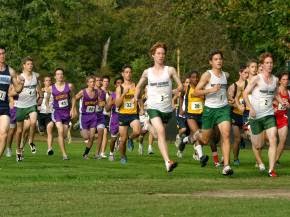
I am lying on my back, looking up at the sunny, clear autumn sky as we perform our stretches in the west end zone of the football field.

The cross country season is in full swing. Our meets are normally on Tuesdays, and so the coach has designated Wednesdays as our long run days. We do not have to push ourselves for time- for a fast run on Wednesdays- but the coach expects us to go eight miles.

As we stretch, Penny, a cute blond on the team, sits close to me along with her friend, Dawn. I try to start a conversation with her as the coach walks around.

"Are you taking a foreign language this year, Penny?" I ask.

"I'm in Spanish II," she answers.

"I'm taking French," I say. " My teacher says that French is a much more developed language than Spanish. English is more developed than either of them."

Penny does not say anything.

"For example, in English, the words 'brain' and 'mind' have two different meanings. But Spanish has no separate word for brain and mind. That language just uses one name, or so my teacher says."

Flat on my back, I can not see Penny's reaction, but she says nothing. The coach comes around and looks down at me with a curious expression.

After our stretches, we head out from the high school into town, on the designated route for our run.

I ran 10 miles not too long ago, and I really do not feel the need to go eight miles today. None of the guys on the team do. All the girls are running together, though, separate from us boys. They are ahead of us but within sight, putting in a good pace, trying to get the run finished in a reasonable time.

David, one of the guys on the team, says he knows a short cut that will slice about two miles off the run.

All the guys agree to go with him, and we make sure the girls do not see us as we take a right off the main road.

Of course, we arrive back at the high school well before the girls. The coach is waiting for us.

I expect him to make some comment about how fast we did the eight miles, but I can tell he does not care. In addition to cross country, he is the head basketball coach at the high school. This is more on his mind and is his passion. The best runner on our team joined in part because he wants a starting slot when basketball season starts.

When the girls do finally get back, we are standing around under a tree, waiting on them. The coach has gone inside the school for a few minutes.

The shock on the girls' faces amuses me. David sees the opportunity to needle them a bit.

"What took you all so long?" he asks.

For whatever reason, this sets Dawn off. She launches into a heated diatribe against us guys and how we cheated. She says we should be ashamed of ourselves.

David is as shocked by Dawn's reaction, and I have to laugh at his facial expression, too.

"I'll do it again!" he says to her.

***

From then own, Dawn is always fussing at David, no matter what he does. Dawn is a pretty girl, and it is entertaining to watch her get so worked up.

The coach notices how she seems irritated by David as well. One day after she has said something harsh to David, the coach speaks.

"You know what you need to do, Dawn? You need to get yourself a young man like that, and cultivate him."

I burst out laughing. The phrase "cultivate him," and the way it sounds in the Robeson County accent of my coach cracks me up.

Dawn turns and glares at me with venomous eyes.

***

About a year later, I saw Penny in a Waldenbooks in Fayetteville. I tried to speak to her, but I could tell now that our shared connection of the cross country team had ended, she no longer had any interest in interacting with me. Or maybe it was just that I could not think of any good lines to say to her in Waldenbooks.

I also saw Dawn some months later, out in town in Lumberton. She was going to walk past me without saying anything, but I spoke to her. She stopped and wheeled, breathing a bit heavy, like out of exasperation.

I had more confidence with Dawn, but all I knew to ask her was what she was doing after high school. She said she was looking into some community college programs.

That was it. That was all that I had in my head to speak. Maybe it was my imagination, but I thought she gave me a look like I had missed an opportunity. She turned and walked away, and I never saw her again.

In the years since I ran on the cross country team, my instincts in knowing what to say to women has only marginally improved.

Sunday, September 22, 2013

The Gap

My favorite place on the planet is Cullowhee, North Carolina.

That small town is home to Western Carolina University, where I spent five of the most important years of my life. I attended WCU from August 1995 through May of 1998, or three academic years. Then I dropped out of college for a year, before returning in August of 1999 and earning my degree in May of 2000.

In August of 2007, I came back to WCU as a student in the Master of Arts History program. After assessing the job market for people with history degrees, however, I decided to leave after a year and enroll in law school. That appears to have been a wise decision, though I had a blast in Cullowhee.

Western Carolina University and the surrounding towns- Cullowhee, Sylva and Dillsboro have a wonderful, magical place in my mind. My undergraduate years at WCU were the most important in forming who I am as an adult. A decade after that, the lone year in graduate school is still the happiest year I have had in my life so far.

Even now as I type these words, though, I do not want to write about my experiences at Western. The memories are too intense, and I think that frankly I have suppressed most of them just so that I can focus on getting through my days in the present.

I would not do the memories or the magic justice, sitting here at a desk in Florida. If I ever get the chance to spend a significant amount of time in Cullowhee again, then I am sure the old emotions will come flooding back and I will want to record them.

But for now the memories are just too happy, too sad... too "raw" for me to put myself through such an exercise. I said August 2007 through the summer 2008 was the happiest span of my life. I lived life like I wish I had done as an undergraduate. So I do not want to try and revisit that extreme high. It would be too painful to come back down.

In turn, September 1997 through the spring 1998 in Cullowhee was the most painful year of my life. I grew my hair out, got an ear ring and tried to grow a beard. One of my best friends from WCU refers to it as the year that I decided to be a pirate. It was the year before I dropped out. I remember going to a hockey game in Fayetteville over the Christmas break in 1997 with my dad, brother, and my uncle. I overheard my uncle comment to dad about me, "He looks wiped out."

That was the year I lost faith in a god that loved us, and I truly began to understand what loneliness meant. I do not care to revisit my discovery of those dark places, either.

So there is a gap in this blog about my experiences- a very significant gap. The first blog I ever wrote was for the Graduate Student Association at WCU, when I was there in 2007 and 2008. That captures some of what the happiest year was like for me, but only a small portion.

I could spend an eternity exploring that time. The smell of the buildings at Western, the way the trees and plants looked in different seasons of the year, the heat of the summer and the cold of the winter there, the extreme beauty of how young we all were then, how I changed in that place, and so much more. And so much more. But there is no going back, unless a heaven exists. It makes my chest feel like it is going to explode as I type this draft on a Saturday evening.

I have to stop. There will just be a gap. It was a total of five years of my life. Five years now, in the present, will pass by very quickly, I believe, without nearly the significance. Those five years at Western, though, were the most important and most treasured years of my life. It is too hard to write about them.

Sunday, September 15, 2013

The Irrelevance of iPhone Shell Shock

Millbrook K-12 School, Raleigh, North Carolina. 1983.

It is my group's turn to do exercises. Today, these exercises will be on the new computers. It hurt my feelings a bit when, a few weeks ago, the teacher did not assign me to the first group, supposedly the smartest students in my first grade class. I have been placed in the group of second smartest students. She did not tell us how she was classifying the groups, of course, but I know. The first group is ahead of mine on the number of exercises completed. My group is ahead of all the others.

I sit down in front of one of the computers, looking at the big blue screen while the other students in my group take their places as well. It is the first time that I have ever seen a computer in person or touched a keyboard. The teacher's aide, a lady with dark red hair and thick glasses, sets up the program for me. It is a series of spelling exercises.

A cartoon, computer graphic image of a bare, pink skinned foot appears. Five dotted lines are below the picture- the spaces to type in letters- and an automated voice says, "Ankle. Spell ankle."

I type in the letters slowly in the five blank spaces, searching for them on the keyboard. A...N...K...L..E. Then I press the "enter" key.

"That is incorrect," the voice says. "Spell ankle."

Confused, I type in the word again. a...n...k...l...e.

"That is incorrect. Spell ankle."

A...n...k...l...e.

"That is incorrect. Spell ankle."

Maybe the computer is wrong, I think. So I try an incorrect spelling.

a...n...k...e...l.

"That is incorrect. Spell ankle."

I raise my hand in frustration.

The teacher's aide comes over, a small and sour frown on her face. I do not think she likes me that much, as I do not like school. It was much better when Mom taught me at home. I did not have to go to kindergarten because she taught me at home, and this is my first year of being in a classroom and being around other students.

"I am trying to spell ankle, but it keeps telling me that I am wrong," I say to her.

"Well, type it in again," she says.

She watches as I press the keys a...n...k...l...e. Then I press enter.

"That is incorrect. Spell ankle."

I look up at the teacher's aide. Now she looks confused, and I feel vindicated.

She leans over and tries to type the word in herself.

"That is incorrect. Spell ankle."

"Go have a seat back at your desk, " she says. "I'll see if I can fix this."

I walk across the classroom back to my desk, and watch as she tries to get past the "ankle" screen to no avail. She calls over the regular teacher, Mrs. Hawkins, and the two of them try to figure out what is going on. Meanwhile, the students on the other computers type away, and I get an anxious feeling that I am being left behind.

The teacher's aide ends up turning off the computer, and I do not get to do any exercises that day...

Thus begins my rocky relationship with technology and computers.


***

Present day.


One of the reliefs of my new job in Live Oak is that I do not have an iPhone.

I work hard here, putting in much more than 40 hours per week. A difference between being a government lawyer and a lawyer at a private firm, though, is that when I leave the government office, the work stays there. My mind is free to think about other things if I choose. That is rarely the case in private practice, where you always have to be ready to take a phone call and make money for the firm.

Last year, I held a job in sales. As part of our company issued gear, I was given an iPad and an iPhone. I used the iPad for one day, but decided that it was not as user-friendly as my lap top computer. I put it back in its box and never turned it on again.

The iPhone was necessary, though, given the nature of the job. Answering emails quickly was vital, and I answered more than I care to count on the iPhone, punching away at the small screen with my thumbs.

Emails came in at all hours of the day and night- from my boss, from students (customers). The pinging sound that the iPhone made when a new email came in slowly but surely began to grind on my nerves. Each time I heard that sound, it was like being hit with anxiety pellets.

In my job here in Live Oak, there is a prosecutor and some members of the court who have their iPhones set with that same sound when they receive an email. I hear their phones go off when I am sitting in their offices or perhaps the hearing room. Each time I hear it, I get a slight nauseating feeling.

World War I veterans would laugh at me for using the term "shell shock" in the title of this blog entry.

Computers have made my life better in many ways. I like the internet, Facebook, and Youtube. Writing this blog would obviously be impossible without computers.

But there are many things about computers and smartphones that make me feel stress and unhappiness, too. I do not like text messaging, tweets, iPads and iPhones.

What I have discovered though, is that no one cares what I do not like about computers and smart phones. I feel like I am the only person on the planet who prefers to stare out a window as opposed to messing with an app on an iPhone. If I do not participate in the newest wave of technology, then I run the risk of quickly becoming irrelevant in my job and even in social circles.

So far, anyway, this job is very satisfying in that I still get to work with printed books and printed files. I hand write my notes on a legal pad. Westlaw and the internet provide important research functions, but I am lucky in that the vast majority of my time consists of face to face contact with people, working with paper and pen, and working within my own creativity with the facts of the case in front of a judge or jury.

It is a refuge from the pellets of anxiety being lobbed at me, a foxhole to protect against the strange and unpleasant electronic sounds of an incoming shell...I mean incoming email.